A Tier List of 20 Corporate Buzzwords
Twenty corporate buzzwords, ranked from genuinely useful to absolutely unforgivable. Plus a free tool to build your own tier list and send it to your team.
By Blake Johnston
Someone in your meeting just said "let's circle back on that next week." You watched it happen. The phrase entered the room, bounced gently off three people, and left without doing anything. Nobody is going to circle back. The phrase exists to end a conversation while pretending to keep one open. That's its job. That's its only job.
This is corporate jargon. A whole vocabulary of soft, hedging, plausible-sounding phrases that nobody questions because everyone uses them. Some of it is genuinely useful. There are concepts you can't name in plain English without taking a paragraph, and a single shared phrase saves time. Most of it is filler. A tax on meeting time. A way of sounding professional without saying anything.
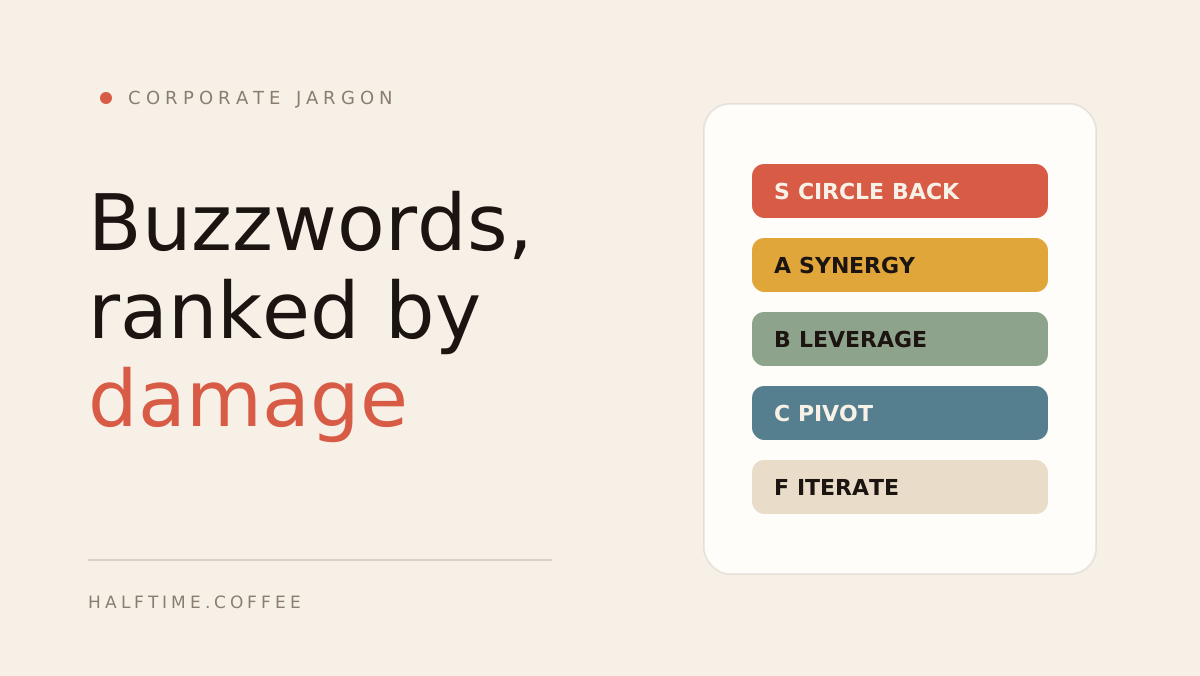
I have ranked 20 of the most common offenders into a tier list. S tier is iconic, the ones that should be removed from the language by force. F tier is the small minority that have earned their keep. Your ranking will be different from mine, and that's exactly why the tool to make your own and send it to your team exists.
S Tier: Strike on sight
The unforgivables. If you say one of these in a meeting, the meeting should end and you should think about what you've done.
"Circle back." The original sin. It means "I don't want to deal with this right now and I'm going to commit to nothing in a way that sounds productive." There is a 3% chance the circling-back ever happens. The other 97% it dies on the calendar.
"Synergy." A word that has been a punchline for twenty years and somehow still gets deployed without irony in actual decks. If two teams have synergy, they have it. If you have to declare it, they don't.
"Boil the ocean." Said by someone who thinks they're being wise. It means "do too much" but it's almost always used to shut down a perfectly reasonable suggestion. Whoever first said it should boil it.
"Run it up the flagpole." What you say when you want to look like you're going to advocate for something while signalling, very clearly, that you're not. Nobody salutes the flag. The flag stays at half-mast forever.
A Tier: The repeat offenders
Genuinely annoying. Said too often, mostly content-free, but you can usually figure out what the person means. Demoted from S only because they haven't yet replaced an actual sentence in someone's vocabulary.
"Touch base." Just say "talk." We don't need a baseball metaphor for sending a quick message.
"Pick your brain." What you say when you want someone's expertise for free. The brain doesn't enjoy this. The brain has work to do.
"Move the needle." Means "make a difference." But "make a difference" sounds vaguely like a charity slogan, so we say "move the needle" to feel more like operators. The needle has not moved.
"Low-hanging fruit." Means "the easy thing." Used by people who want to sound like they're prioritising while in fact dodging the hard problem. Real low-hanging fruit gets picked, not discussed in a 45-minute strategy meeting.
B Tier: The forgivable filler
Overused, slightly hollow, but at least they're trying to point at something real. You will say these. I have said these. We will continue to say these. We can do better but probably won't.
"Deep dive." Means "spend more than ten minutes on a thing." Has the bonus problem of making any non-deep-dive sound like a shallow waste of time. Sometimes the meeting is a snorkel and that's fine.
"Take it offline." Used when a meeting derails into something only two people care about. This one I almost respect. It's actually doing a job, and the job is to get the rest of us back to the agenda.
"Bandwidth." Borrowed from networking and now used to mean "time and attention." Mostly fine. Suspect when used as a way to politely say "no" without saying "no."
"Ping me." Just say "message me." Fine, ping me. I'll allow it.
C Tier: The mostly harmless
These are doing real work. They're slightly overused but they're not pretending. You can use them in a meeting without losing dignity, as long as you don't use more than one per sentence.
"Align." Means "agree on this." It's a bit corporate but it captures something useful: a quiet form of agreement that doesn't require everyone to say "yes" out loud. The phrase has earned its place. I will not fight you on this.
"Iterate." A real word doing real work. We make a thing, we look at it, we change it, we look again. If you find a one-syllable replacement let me know.
"Stakeholder." Sounds important and is. Sometimes it's the only word that captures "people who have an opinion on this and aren't on the team." If you find yourself saying it five times a day, maybe ask why so many people have opinions.
D Tier: Actually fine
The rare jargon that actually does its job. Kept down here in the lower tiers rather than promoted because it's still jargon, and we want to remember that. But you can keep it.
"Pivot." Used to mean a real strategic change in direction. Has been over-applied to mean "we changed our mind on something small," which is a shame, because the original sense is genuinely useful. If you're using it correctly, you've earned it.
"Game changer." Lazy. But I cannot be mad at "game changer" because every once in a while there is, in fact, a game changer, and sometimes that's the only phrase that fits. Nine times out of ten it's not. The tenth time it is.
"North star." Slightly grandiose. Says "the thing we're orienting toward that we won't change every quarter." If you actually have one, you're allowed to call it that. If you have three north stars, you have zero.
F Tier: Allowed to stay
Inverted from gaming convention on purpose. In this list, F tier means "earned its keep, please leave it alone."
"Leverage." Hate it as a verb if you must, but "leverage X" means "use X to amplify Y," which is two words shorter than the alternative. If a phrase saves syllables and means something specific, it's pulling its weight.
"Drink the Kool-Aid." Worth keeping for the dark history of it. (It's a Jonestown reference, and people do seem to forget that.) But also worth keeping because there's no clean phrase for "buy in so completely you've stopped questioning anything." A phrase can be uncomfortable and useful at the same time.
Your turn
Buzzword tier lists are a sport. Mine is going to be different from yours, and yours is going to be different from your colleague's, and that's the entire point. The fastest way to find out who on your team has been quietly accumulating opinions about "stakeholder alignment" is to send them a tier list and ask them to defend their ranking.
Build yours in the break room. Drag the same 20 phrases into S, A, B, C, D, or F. Copy the result. Paste it in your team chat. Watch the debate unfold. Discover that the person who runs your standups has been quietly furious about "deep dive" for three years.
It's free, no signup, no email. Just a small offering to the cause of saying what you mean.
Most jargon lives in meetings that didn't need to happen. The math on what those meetings actually cost is bleak. Halftime is a 2-minute daily game your team plays together. Async, no calendar invite, no circling back. Free for 30 days, no card needed.
FAQ
Common questions
What are the worst corporate buzzwords?
Four S-tier offenders worth retiring on sight: "circle back" (commits to nothing while sounding productive), "synergy" (a punchline for twenty years still deployed without irony), "boil the ocean" (used to shut down reasonable suggestions), and "run it up the flagpole" (visible refusal to advocate). Just below them: "touch base", "pick your brain", "move the needle", and "low-hanging fruit".
What does "circle back" actually mean?
It means "I don't want to deal with this right now and I'm going to commit to nothing in a way that sounds productive." About 3% of the time the circling-back actually happens. The other 97% of the time, the action item dies on the calendar. The phrase exists to end a conversation while pretending to keep one open.
Are corporate buzzwords ever useful?
A few are. "Iterate" is doing real work (we make a thing, look at it, change it, repeat). "Stakeholder" captures "people who have an opinion on this and aren't on the team" cleanly. "Pivot" is genuinely useful when used correctly (a real strategic change, not a small mind-change). "Leverage" earns its keep because "use X to amplify Y" is two words shorter.
How do you stop using corporate buzzwords?
Translate before you speak. If "circle back" is on the tip of your tongue, replace it with "I'll get back to you by Thursday" (commits you to a deadline). If you're about to say "low-hanging fruit", say "the easy thing" (and notice whether you're actually proposing the easy thing or dodging the hard one). Most jargon is filler that hides the lack of a specific commitment underneath.
Why do people use corporate jargon at all?
Two reasons. First, it sounds professional without saying anything, which is useful when you don't want to commit to a specific thing. Second, it's contagious; once a few people on the team adopt a phrase, the rest absorb it without ever choosing to. The fix is intentional translation: notice when you reach for jargon and ask whether a plainer sentence would say more.