Employee Engagement Activities for Small Teams: A Manager's Operating System
A practical employee engagement operating system for small teams: five loops, a weekly cadence, and activities that create real participation.
By Blake Johnston
Employee engagement activities are usually presented as a menu.
Try a trivia night. Run a workshop. Host a lunch-and-learn. Send a survey. Do a team-building exercise. Add a shoutout channel. Buy cupcakes. Put "wellbeing" in a calendar invite and hope nobody notices that the invite is at 4:30pm.
Some of those things can be fine. None of them are a system.
That is the mistake small teams make. They look for employee engagement activities when what they actually need is an operating rhythm. Not a bigger event. Not a culture committee. Not a spreadsheet full of initiatives. A simple way of running the team so people stay clear, recognized, heard, connected, and trusted.
That is why Halftime frames employee engagement as a daily intervention, not another dashboard. Measurement matters, but participation is what changes the texture of the week.
Engagement is not excitement. Most people do not need work to feel like a festival. They need work to feel worth showing up for.
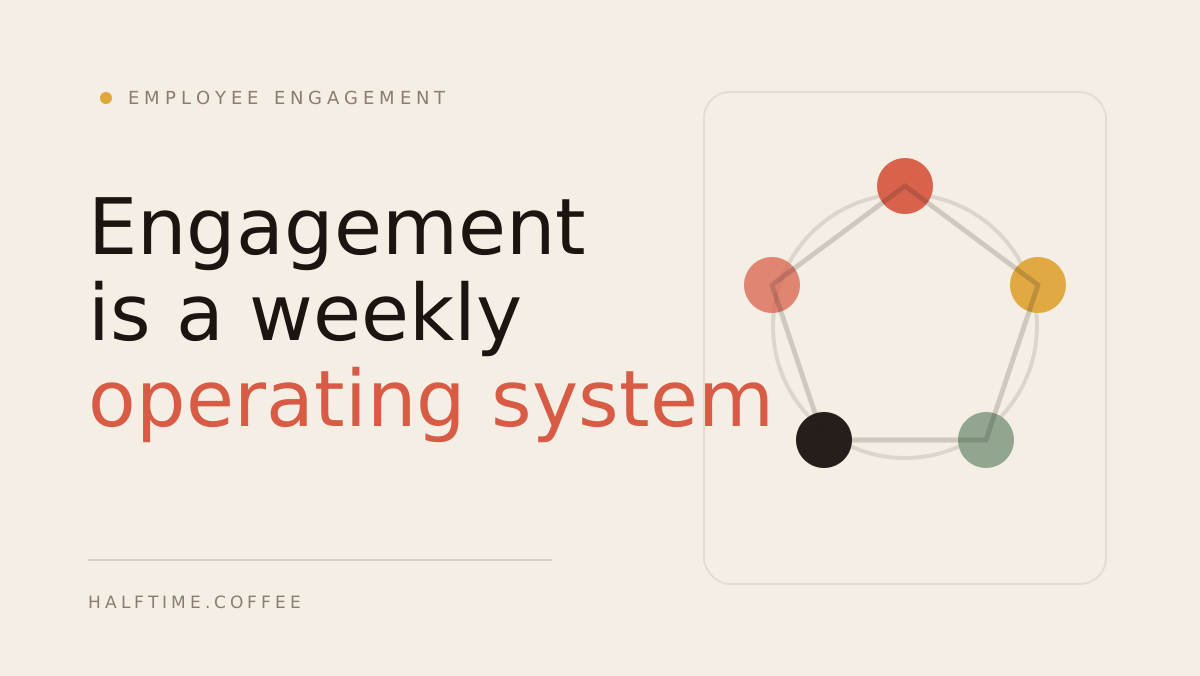
For a small team, that comes from five loops.
The five engagement loops
Think of employee engagement as a set of loops, not a set of events.
Each loop answers one question people are quietly asking all the time:
- Clarity loop: Do I know what matters?
- Recognition loop: Does anyone notice useful work?
- Feedback loop: Does my input change anything?
- Connection loop: Do I know the people I am working with?
- Autonomy loop: Do I have any control over how the work happens?
If one loop is broken, the team can still function. If three are broken, no amount of cupcake energy will save you.
This is why one-off engagement activities disappoint. A team lunch might help the connection loop for an afternoon. It does nothing for unclear priorities, ignored feedback, or a manager who recognizes only the loudest person in the room.
Small teams need activities that keep these loops moving every week.
Loop 1: Clarity
The first engagement activity is telling people what matters.
That sounds too basic to count. It counts more than almost anything else.
Disengagement often looks like apathy, but underneath it is confusion. People stop leaning in when priorities shift without explanation, decisions appear from nowhere, or everything is apparently urgent until the next thing becomes apparently urgent.
Run a weekly clarity ritual:
Every Monday, write the top three outcomes for the week.
Not tasks. Outcomes.
- "Ship the onboarding email update."
- "Decide whether the timezone tool needs account storage."
- "Reduce support backlog below 10 open tickets."
Then add one line on what is not a priority. This is the part managers skip, and it is the part that gives people oxygen.
People engage more when they can see the shape of the week.
Loop 2: Recognition
Recognition has to be specific or it becomes wallpaper.
"Great work this week" is polite fog. It makes nobody feel seen because it could apply to anyone. Specific recognition is different. It tells the team what good work looks like.
Use this prompt every Friday:
"Who made the work easier this week, and what did they do?"
That question is doing three jobs:
- It rewards helpful work, not just visible work.
- It teaches the team to notice contribution.
- It creates a record of what the team values.
The answer might be small. That is the point.
"Sam rewrote the confusing customer handoff notes."
"Mia caught the edge case before QA."
"Priya made the decision clear in the thread instead of making us meet."
Specific recognition is one of the cleanest employee engagement activities because it compounds. Over time, people learn that useful work gets noticed even when it is not dramatic.
Loop 3: Feedback
Do not ask for feedback unless you are willing to close the loop.
This is where engagement surveys quietly damage teams. People answer honestly, nothing changes, and the lesson becomes: feedback is theater.
Small teams can avoid this by asking smaller questions more often.
Once a week, ask one question:
- What slowed you down this week?
- What decision felt unclear?
- What are we pretending is fine?
- What is one thing we should stop doing?
- What did leadership miss this week?
Then pick one response and act on it within seven days.
Not all feedback needs a company-wide plan. Sometimes the best engagement activity is fixing the annoying thing immediately.
The formula is:
Ask one thing. Change one thing. Say what changed.
That last part matters. People need to see the loop close.
Loop 4: Connection
Connection is where most employee engagement advice turns into forced fun.
The intent is right. Teams work better when people know each other. The execution is usually the problem: mandatory socials, performative icebreakers, virtual happy hours, and after-work events that punish anyone with a life outside the company.
Connection activities should be low-pressure and easy to skip.
For small teams, the best connection loop is a lightweight weekly touchpoint:
- a random pairing
- one async prompt
- a two-minute daily game
- a small team challenge
- a rotating "what are you learning?" note
The activity matters less than the properties:
- short
- opt-in
- no emotional ambush
- no attendance judgment
- creates something people can talk about later
This is the same reason I keep arguing against mandatory fun. If you have to force participation, you have not created engagement. You have created compliance with snacks. The longer argument is here: The Case Against Forced Fun at Work.
If you want a practical version, use a small daily ritual. Halftime is one version: a two-minute game every workday, async, opt-in, and visible enough to create conversation without requiring a meeting.
Loop 5: Autonomy
Autonomy is the least flashy engagement loop and probably the most important.
People disengage when work feels done to them. Priorities arrive from nowhere. Process is inherited. Meetings appear. Tools multiply. Nobody asks what would make the work less stupid.
The activity here is simple:
Every two weeks, remove one friction point.
Ask:
- What costs more energy than it is worth?
- What approval step can we delete?
- What recurring meeting no longer earns its slot?
- What do we keep doing only because we have always done it?
Then remove one thing.
This is engagement because it proves people have influence over their environment. A team that can shape its own work will tolerate a lot. A team that cannot shape anything eventually stops trying.
A weekly engagement cadence for small teams
Here is the operating system in one week:
Monday: clarity Post the top three outcomes and one explicit non-priority.
Tuesday: connection Run one lightweight touchpoint: a random pairing, async prompt, or two-minute game.
Wednesday: feedback Ask one pulse question. Keep it specific.
Thursday: follow-through Respond to last week's feedback. Show what changed, what will not change, and why.
Friday: recognition Ask who made the work easier and what they did.
That is it. No engagement committee. No giant program. No "culture calendar" that becomes another artifact people maintain instead of doing their jobs.
The cadence is the activity.
What to measure
Do not over-measure small-team engagement. You will make it weird.
Still, you need signals. Use behavioral ones before survey ones:
Participation quality. Are people joining optional rituals because they want to, or because the manager is watching?
Feedback usefulness. Are pulse answers getting more specific over time?
Meeting energy. Do people volunteer useful thoughts before being cold-called?
Follow-through speed. How long does it take for team feedback to turn into a visible change?
Cross-team help. Are people helping outside their narrow job lane?
Retention risk. Are your best people withdrawing, going quiet, or opting out of everything?
A quarterly survey can still help, but it should not be the only instrument. By the time the survey tells you the team is checked out, the team has usually known for months.
If you have already run the survey, the next job is follow-through. Use what to do after an employee engagement survey to turn the results into visible actions, or use employee engagement action plan ideas if you need concrete options for connection, recognition, meetings, feedback, and clarity.
Common mistakes
Mistake 1: Treating attendance as engagement.
People can attend every activity and be completely checked out. Attendance tells you who was present. It does not tell you who cares.
Mistake 2: Running activities without fixing friction.
If the team says meetings are the problem and you respond with a trivia session, you have made the problem louder.
Mistake 3: Making connection too intense.
Not every activity needs vulnerability. Most teams need more lightweight familiarity before they need deep sharing.
Mistake 4: Asking for feedback and disappearing.
An unanswered feedback request is worse than no request. It teaches people not to bother next time.
Mistake 5: Copying big-company rituals.
Small teams have different advantages. You can move fast. You can fix one thing this week. Use that.
The best engagement activity is proof
The best employee engagement activity is not a game, a survey, a workshop, or a recognition channel.
It is proof.
Proof that priorities are clear. Proof that useful work is noticed. Proof that feedback changes something. Proof that people can connect without being forced into fake enthusiasm. Proof that the team has some control over how work happens.
Small teams do not need more engagement theater.
They need loops that close.
If your connection loop needs a low-pressure ritual, Halftime gives the team one two-minute game per workday. It is async, opt-in, and free to run for 30 days, no card needed. Try a game first.
FAQ
Common questions
What are the best employee engagement activities for small teams?
The best employee engagement activities for small teams are the ones that create repeatable loops: clear priorities, specific recognition, visible feedback follow-through, lightweight connection, and autonomy over how work happens. Small teams do not need large programs. They need a weekly operating rhythm people can trust.
How do you build employee engagement in a small team?
Build employee engagement in a small team by making priorities clear, recognizing specific contributions, asking for feedback and acting on it quickly, creating low-pressure ways for teammates to connect, and removing friction from the work. Engagement improves when people can see that their work matters and their input changes something.
What should managers do weekly to improve engagement?
Each week, managers should clarify the team's top priorities, recognize specific helpful work, ask one useful pulse question, close the loop on a recent piece of feedback, and create one lightweight team touchpoint. The cadence matters more than the size of the activity.
How do you measure employee engagement without a big survey?
Small teams can measure engagement with simple operating signals: participation in optional rituals, response quality in pulse questions, meeting energy, follow-through on feedback, retention risk, and whether people volunteer ideas without being prompted. A quarterly survey can help, but weekly behavioral signals are often more useful.