The case · For leaders thinking about culture
Culture isn't built at offsites. It's built between meetings.
Halftime gives every team one small shared thing to play, compare, and talk about each workday.
Two minutes a day · One team or every team in the org · No facilitator
“We were experiencing low morale across the team and your app boosted morale within days.”
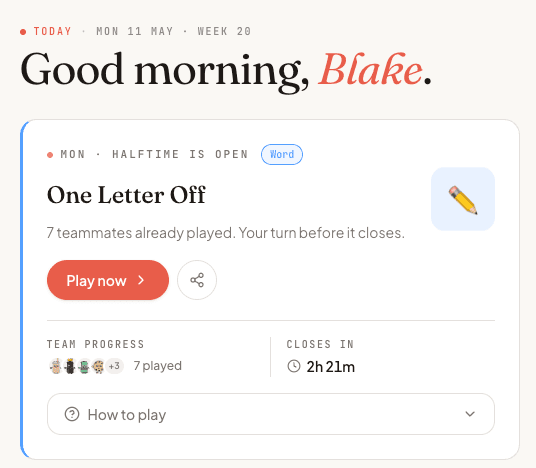
Today's game
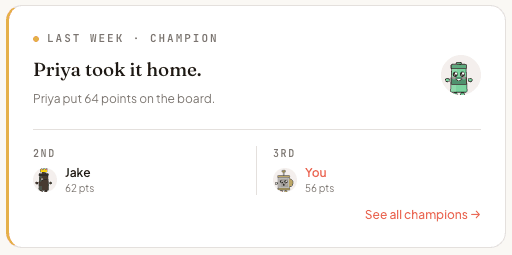
Last week
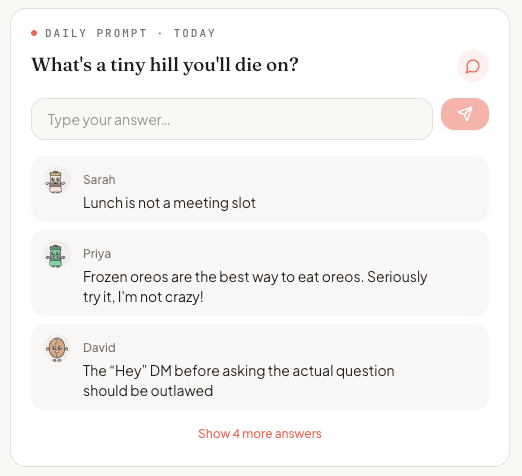
Quarterly events peak then fade. Daily moments compound.
Annual surveys measure how people feel. Offsites lift the mood for a week. Forced fun usually backfires. What actually shapes a team is the 200th low-stakes interaction, not the one big day on the calendar.
Halftime turns that belief into a repeatable habit: two minutes, every weekday, between the meetings.
One game. All day. Results at four.
A new game opens at 9. People play whenever there's a moment: over morning coffee, between meetings, before the next call. By 4pm, scores reveal, the leaderboard updates, and the conversation starts.
The game changes daily across 50+ formats: arcade, drawing, word, trivia, puzzle, and strategy. Variety keeps the ritual from becoming another stale workplace routine.
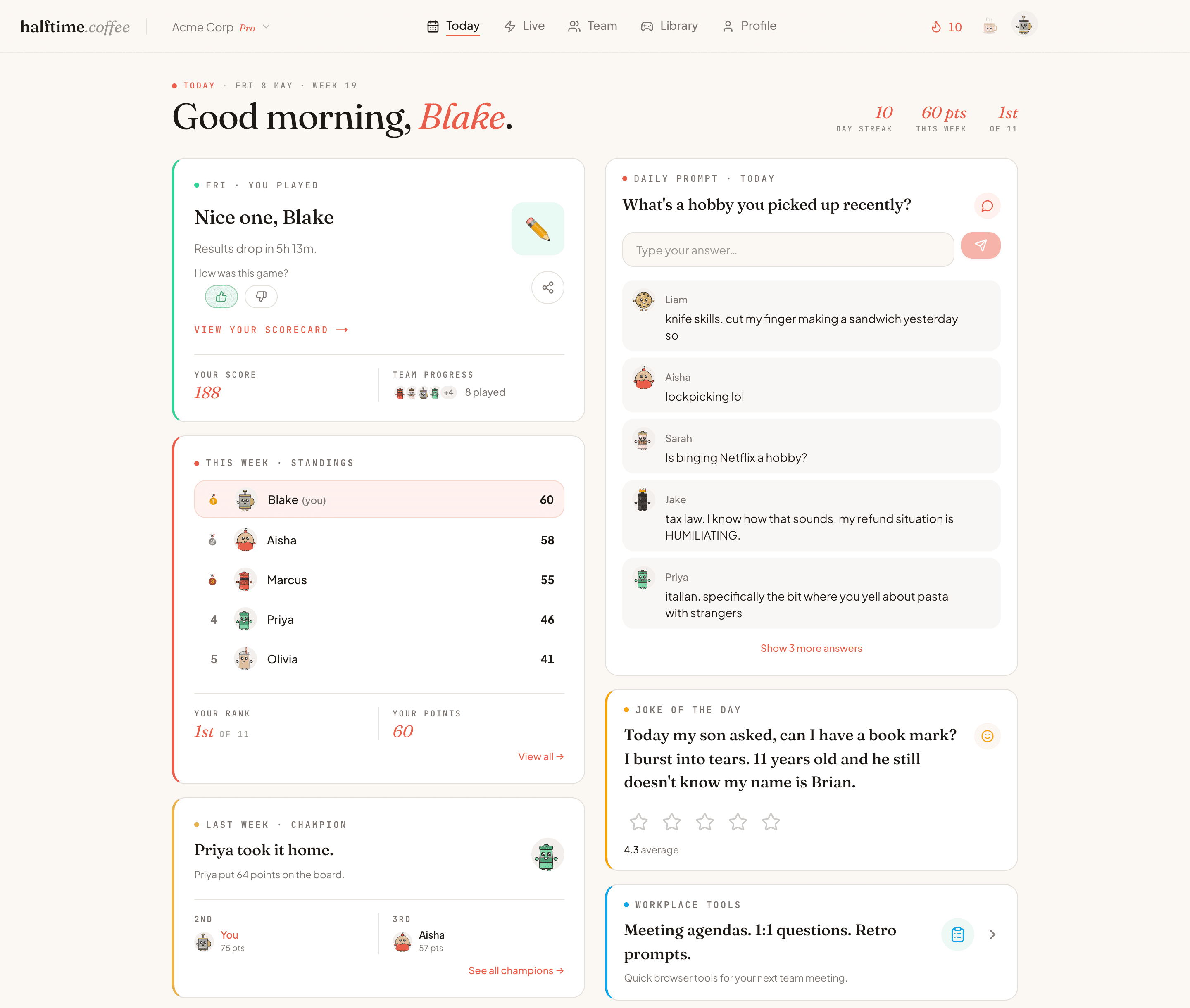
Ready when the team is
Run it with one team first.
Start with a small pilot, see whether people actually play, then decide if it should roll out wider.
Not another survey. Not another meeting.
Halftime sits beside the tools you already use. It does not replace surveys, offsites, 1:1s, or management. It fills the quiet space between them.
vs Surveys
Surveys tell you where morale is. Halftime gives people something to share.
Use both. Measure sentiment occasionally. Create connection daily.
vs Offsites
Offsites create a peak. Halftime creates a rhythm.
The big day still matters. The small repeat is what survives Monday.
vs Donut & coffee chats
Coffee chats schedule time. Halftime uses the gaps people already have.
Async, opt-in, no calendar invite. People play when they have two minutes.
vs Kahoot & forced fun
Live games work for events. Daily rituals need less production.
No host, no question writing, no meeting block people have to perform in.
Start small. Then scale what sticks.
Halftime is sized at the team: five, eight, twelve people. That's the level where conversation actually happens. Larger organisations can run many teams in parallel, each with its own rhythm, schedule, and leaderboard.
The cleanest rollout is one team or one department first. If people come back on their own, expand from there with central billing, admin controls, Slack, Teams, and email notifications.
Built for the org
Central admin for multi-team companies.
Department-level visibility, central billing, and an admin console for the wider rollout.
Integrations
Slack, Teams, and email out of the box.
Daily notifications, results threads, per-team channels. Configure or turn off per team.
Configuration
Per-team timezone, schedule, and library.
Each team sets its own hours and active games. No global rollout needed. Admins oversee from a single console.
Pricing
Pro for one team. Company for many.
Flat team pricing, monthly or annual. Company and enterprise options are available for multi-team rollouts.
Enterprise checklist
Pilot first
Run one team or department before asking the company to adopt a new habit.
Admin-ready
Central billing, admin controls, multi-team companies, and department-level visibility.
IT path
Slack, Teams, and email support, with a lightweight security and procurement review path.
You do not need a culture thesis. You need a signal.
A small pilot answers the practical question first: will this team voluntarily come back to the same shared thing more than once?
What to watch
Repeat play, not perfect participation.
- People come back without a manager reminding them every morning.
- Scores, prompts, and jokes create small threads in Slack, Teams, or the room.
- Quieter teammates get a low-pressure way to show up.
- Someone unexpected starts winning, and the team notices.
What not to overclaim
A game is not management.
- It will not fix burnout, bad incentives, or unclear leadership.
- It does not need every teammate to play every day to be useful.
- It should feel optional, light, and easy to skip.
- The real win is a little more shared context than the team had yesterday.
The practical test
Give one team a month.
If they keep playing, you have a useful signal. If they do not, you learned quickly without rolling out another company-wide program.
Reasonable objections. Answered plainly.
Is this mandatory for employees?
It works best as an opt-in daily ritual. The point is to create a lightweight opening, not another required meeting.
What if only half the team plays?
That is still useful signal. Most teams do not need perfect participation for scores, prompts, and small conversations to start showing up.
Does it work across time zones?
Yes. Each team can set its own schedule and timezone, and people play whenever they have two minutes inside the window.
Can we start with one team?
Yes. Start with one team or department, then expand if the habit earns its place.
How do we know if it is working?
Look for repeat play, score chatter, prompt replies, and people referencing the game without being asked. It should create a small shared thread in the week.
The next step
Want to see it on your team?
Start with one team, see whether people come back, then decide if the ritual should roll out wider.