Slack Engagement Rituals That Don't Become Channel Noise
Slack engagement rituals for remote teams: daily games, Donut-style prompts, recognition threads, async check-ins, and the notification rules that keep them useful.
By Blake Johnston
Slack engagement rituals sound like a People Ops thing until the channel goes quiet.
Then they become a manager problem.
The team is still working. Tickets move. Meetings happen. Updates get posted. But the channel has no texture. Nobody reacts unless they have to. New people learn the process but not the people. The only recurring social moment is someone posting "happy Friday" into the void.
That is the gap Slack rituals are supposed to fill.
The mistake is treating Slack like a magic engagement machine. Slack is not the ritual. Slack is where the ritual shows up.
A useful Slack ritual gives the team one small repeated moment: a question, a game, a pairing, a win, a prediction, a result. A bad one turns culture into a drip campaign.
The rule for Slack rituals
Every Slack engagement ritual should pass this test:
Would someone still like this if they were busy today?
If the answer is no, the ritual is too heavy.
Remote teams already have enough notifications. The point is not to make the channel louder. The point is to create a small shared signal that people can join, ignore, or react to without social debt.
That usually means:
- One clear prompt or link.
- One place where it lives.
- One result or follow-up.
- No repeated tagging.
- No manager chasing participation.
The ritual should create conversation, not homework.
1. Daily team game
A daily game is the highest-frequency Slack ritual, so it has to be the smallest.
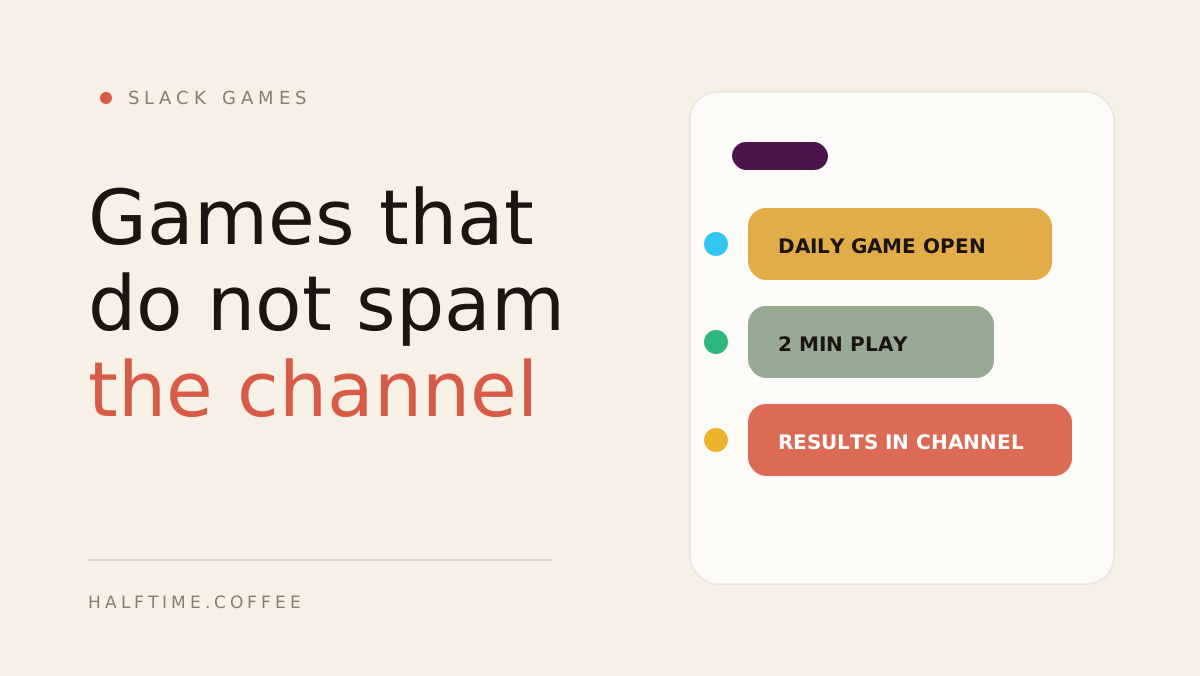
The useful version opens once a day, lets people play in the browser when they have two minutes, and brings a result back to the channel. The result matters because it gives people something to react to: a score, record, weekly champion, near miss, or suspiciously good performance from someone who claims they "barely tried."
That is different from a live game in a meeting. Live games require timing. Async games create a window.
This is the shape behind Halftime: Slack carries the nudge and the result, while the game itself happens outside the channel so the thread does not fill with mechanics.
Use a daily game when:
- The same team works together every day.
- The channel is functional but flat.
- People are spread across time zones.
- You want connection without adding a meeting.
Do not use a daily game if the team is already overloaded and the game would become one more thing a manager asks about.
2. One-question prompt
One-question prompts are the lightest Slack ritual when you choose the question well.
Bad prompt: "Share a fun fact about yourself."
Better prompt: "Would you rather have every meeting start five minutes late, or every Slack thread split into three side threads?"
The first asks people to perform personality. The second asks them to pick a side.
That distinction matters. Good Slack prompts are easy to answer, mildly opinionated, and not too personal. They create small replies, not essays.
Strong formats:
- Would you rather?
- This or that?
- Wrong answers only.
- Rank these three options.
- One tiny prediction.
- One useful recommendation.
If you need a bank of questions, start with work-friendly icebreaker questions or the Dice Breaker prompt tool. For Slack, cut anything that requires a long personal story.
3. Donut-style pairings
Donut-style pairings are useful when the problem is "people across the company do not know each other."
They are less useful when the problem is "this team does not have shared energy."
That is the distinction to keep straight. Pairing rituals create weak ties. They help new hires meet people outside their immediate work, help departments cross-pollinate, and give employees a reason to have a casual one-to-one conversation.
They do not automatically create a whole-team habit.
Use pairings when:
- The company is growing and people do not know names outside their group.
- New hires need more social surface area.
- Cross-functional relationships matter.
- People can opt in without penalty.
If you are evaluating tools, the Donut alternatives for Slack teams guide breaks down pairing tools, daily team games, recognition, onboarding, and event platforms by use case.
4. Weekly wins thread
Recognition rituals work best when they are specific.
"Shout out someone great this week" sounds nice, but vague prompts produce vague praise. The better version asks for one concrete thing:
- Who made your week easier?
- What got shipped that people might have missed?
- Who explained something clearly?
- What customer problem got solved quietly?
- What tiny improvement deserves more attention?
Run it weekly, not daily. Recognition gets weaker when it feels mandatory or automatic.
The best manager move is to seed the thread with one specific example, then leave room. Do not turn it into a roll call. Do not reply to every mention with performance-review energy. Let teammates notice each other like adults.
5. Async check-in
Async check-ins work when they replace status noise, not when they add to it.
The simplest version:
Today I am focused on:
One blocker or risk:
One thing others should know:
That is enough. If the ritual becomes five fields, three emojis, and a bot reminder that asks how you feel on a ten-point scale, people will start answering like they are filling out customs paperwork.
Use async check-ins for work alignment. Do not pretend they are team building. The engagement value comes from reducing ambiguity and making the team feel less scattered.
6. Prediction game
Prediction games are underrated because they create conversation before and after something happens.
Examples:
- Will the all-hands finish early, on time, or late?
- Which feature request will arrive first this week?
- How many unread messages will this channel have by Friday?
- What will be the most-used emoji this month?
- Which project will generate the first surprise dependency?
Keep the stakes nonsense. A prediction about an individual person's output is not a game. It is pressure with a laugh track.
The payoff is the reveal. Post the answer, let the team react, then stop.
7. Friday closeout
A Friday closeout is not a status report. It is a way to end the week with a little memory.
Good prompts:
- What are you glad is done?
- What deserves a tiny victory lap?
- What should we remember from this week?
- What are we leaving for Monday on purpose?
- What was harder than it looked?
Keep it short. The value is the pause, not the thread length.
This ritual pairs well with a weekly champion, leaderboard, or team game result because it gives the week a finish line that is not just "everyone disappeared at 4:57."
The notification rules
Most Slack rituals fail because they are noisy, not because the idea is bad.
Use these rules:
No repeated @channel tags. One announcement is enough.
One ritual per channel per day. More than that becomes programming.
Put the ritual where the team already talks. Do not create a dead "culture" channel unless there is a real reason.
Make passing normal. Optional rituals survive longer.
Kill quiet rituals quickly. If nobody participates or references it after a few tries, stop with dignity.
Keep play outside Slack when needed. Slack is good for the nudge and result. It is not always good for the whole activity.
A starter cadence
If the channel is quiet, do not launch five rituals at once.
Start here:
Monday: one async team game.
Wednesday: one question prompt.
Friday: one wins or closeout thread.
Run that for three weeks. Then look for pull. Are people replying without being tagged? Are they referencing the game or prompt later? Is someone else starting the thread before you do?
That is the signal.
Engagement is not a dashboard number inside Slack. It is whether the team starts carrying the ritual without being pushed.
If Slack is where your team already talks, Halftime for Slack gives the channel one daily two-minute game, async play, browser-based scores, and results the team can react to. Set up one team.
FAQ
Common questions
What are good Slack engagement rituals for remote teams?
Good Slack engagement rituals are short, optional, repeatable, and visible in the channel without creating constant noise. Daily team games, one-question prompts, weekly wins, Donut-style pairings, recognition threads, and lightweight prediction games all work when they have a clear cadence and a small notification footprint.
How do you keep Slack engagement rituals from annoying people?
Keep each ritual in one channel, post only the opening prompt and the result, avoid repeated @channel tags, make participation optional, and stop rituals that nobody talks about after two or three runs. The goal is a small shared moment, not another notification program.
Are Donut prompts enough for team engagement?
Donut prompts and random coffee chats help people meet one-to-one, especially across a larger company. They are less useful when one team needs a shared habit. Pairing tools create introductions; team rituals create common ground.
How often should a Slack ritual run?
Start weekly if the channel is quiet and daily only when the ritual is genuinely small. A two-minute game can run every workday. A deeper prompt, recognition thread, or pairing ritual usually works better weekly.