How Work Teams Actually Play Daily Games (2026 Benchmarks)
Original data from 10,096 daily team game plays across 52 work teams. Participation rates, the best day and time to post, how long rituals last, and what changes the numbers.
By Blake Johnston
Halftime runs a two-minute game for work teams every weekday, posted to Slack or Microsoft Teams and played in the browser. That gives us a record of when people actually join an optional team activity, how many of them join, and how long the habit lasts. Below are the numbers from 10,096 plays, with the method and the limits spelled out so you can judge how far to trust them.
Key numbers
- Half the team plays on a typical day. The median team had 50% of its members play on a game day. The average was 47%.
- Most plays happen in the morning. 61% of plays happened between 9am and noon local time. 39% came within the first hour after the game opened.
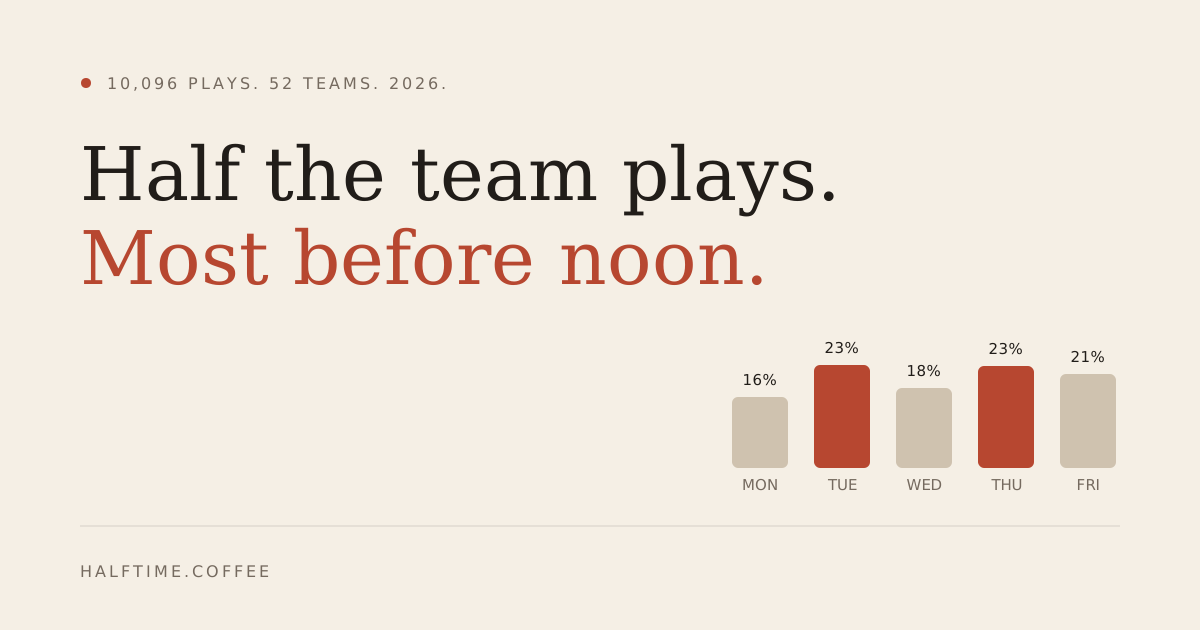
- Tuesday and Thursday are the peak days. They took 22.9% and 22.6% of weekday plays. Monday was the quietest at 15.8%.
- Regular players play most days. 65% of active player-weeks had three or more play days, and 82% of new players came back within a week.
- The biggest drop is after week one. 74% of teams were still playing in week 2, and 55% were still playing in week 12.
- The type of game barely matters. Every category, from word games to arcade games, drew between 3.6 and 3.8 players per game day.
The data behind this post
| Measure | Value |
|---|---|
| Period | April 6 to October 19, 2026 |
| Teams | 52 work teams with three or more members |
| Players | 325 |
| Game plays | 10,096 |
| Median team size | 6 people (average 7.8) |
| Typical game window | Opens 9am, closes 4pm, local team time |
We excluded our own internal teams and any team with fewer than three members, because a team of one or two cannot tell you much about group participation. All figures are aggregated. No team or person is identified.
How many people take part
On a day when the team's game ran, the median team had half its members play. That is a useful number to hold onto, because people who launch a team ritual often expect everyone to join and read anything less as failure.
| Team size | Team-days measured | Average share who played | Median share who played |
|---|---|---|---|
| 3 to 5 people | 828 | 48% | 40% |
| 6 to 10 people | 1,339 | 42% | 38% |
| 11 to 20 people | 501 | 57% | 57% |
| All teams | 2,668 | 47% | 50% |
In absolute terms the median team-day had three players, and the average was 3.8.
A 40 to 60% daily rate is normal for an optional ritual, and it does not mean the other half have checked out. As the habit section below shows, most players skip a day or two each week rather than drop out completely.
The larger teams in our data did better, not worse. Teams of 11 to 20 had a median of 57% playing each day. A likely reason is that a bigger group almost always has someone posting a score early, which gives everyone else a reason to click. Small teams depend more on one or two regulars.
When people play
Time of day
| Local time | Share of plays |
|---|---|
| Before 9am | 11% |
| 9am to 10am | 26% |
| 10am to 11am | 23% |
| 11am to noon | 12% |
| Noon to 2pm | 16% |
| 2pm to 4pm | 11% |
| After 4pm | 1% |
61% of plays landed between 9am and noon. The median player joined 93 minutes after the game opened, 39% joined in the first hour, and 70% within three hours.
Most teams open their game at 9am and close it at 4pm, so the window shapes this curve. Within the window, interest is highest when the game is fresh and falls through the afternoon. If you post a team activity at 2pm, you are asking people to join after the day has filled up.
Day of the week
| Day | Share of weekday plays |
|---|---|
| Monday | 15.8% |
| Tuesday | 22.9% |
| Wednesday | 17.8% |
| Thursday | 22.6% |
| Friday | 20.8% |
Monday is the weakest day by a clear margin, about 30% below Tuesday. Our guess is that people spend Monday morning catching up, and an optional game is the first thing they skip. Tuesday and Thursday are the strongest. Friday holds up better than its reputation suggests.
If you are launching a new ritual, start it on a Tuesday, not a Monday.
How strong the habit gets
| Play days in a week, among people who played that week | Share of player-weeks |
|---|---|
| 1 day | 18% |
| 2 days | 18% |
| 3 days | 22% |
| 4 days | 19% |
| 5 days | 24% |
Once someone plays, they tend to keep playing. 65% of player-weeks had three or more play days, and nearly a quarter had all five. 82% of new players played again within seven days of their first game.
So the half who play on a given day are not always the same half. Regulars play three or four days a week, and on any one day a few of them are busy.
How long rituals last
We looked at the teams that started at least 12 weeks before the end of the data, and checked whether each was still playing in later weeks.
| Week | Share of teams still playing |
|---|---|
| Week 1 | 100% |
| Week 2 | 74% |
| Week 4 | 71% |
| Week 8 | 57% |
| Week 12 | 55% |
The sharpest drop is between week 1 and week 2. A quarter of teams stop after their first week. After that the curve flattens. A team that is still playing in week 4 has a good chance of still playing three months later.
If you run a team ritual, put your effort into the second week. Remind the team on day six, share the first weekly result, and make the leaderboard visible. In week one the game is new. By week two people need a reason to come back, like a result to talk about or a leaderboard to climb.
Does the type of game matter?
| Game category | Players per game day |
|---|---|
| Strategy | 3.84 |
| Arcade | 3.83 |
| Word | 3.80 |
| Trivia | 3.78 |
| Creative | 3.76 |
| Puzzle | 3.62 |
Barely. Every category drew between 3.6 and 3.8 players per game day. Puzzles were slightly lower, probably because a hard puzzle puts some people off on a busy day.
This surprised us. It is easy to spend a long time choosing an activity, but in our data the format mattered much less than running it at the same time every day. Pick games that suit your team's tone and keep the cadence steady.
What we would do with these numbers
- Post in the morning. Open the activity at or before 9am local time, and do not expect much after 3pm.
- Treat 40 to 60% as healthy. That is a normal daily rate for an optional ritual.
- Skip Monday launches. Start on a Tuesday, and do not judge participation by Mondays.
- Plan for week two. That is where a quarter of teams stop. Share a result and a reason to come back.
- Keep it optional. These numbers come from a ritual nobody is forced into. Making it mandatory would probably raise the daily rate and make people enjoy it less. We wrote more about this in the case against forced fun.
Limits of this data
This is one product's data, and it has biases.
- The sample is small. 52 teams is enough to see patterns, but not enough to split by industry or country.
- It only covers teams that got going. Teams that never reached three members are excluded, so these are numbers for teams that started, not for every team that signed up.
- The product shapes the behavior. Halftime opens a game at a set time, posts reminders and shows a leaderboard. A ritual run by hand, without those nudges, will probably see lower numbers.
- Time zones are team-level. We used each team's configured time zone, so a remote teammate in another zone shifts the time-of-day figures slightly.
We plan to update these benchmarks as the sample grows. If you cite them, please link to this page so readers can see the method and the limits.
How to cite this data
Halftime, "How Work Teams Actually Play Daily Games (2026 Benchmarks)", October 2026, based on 10,096 daily game plays from 52 work teams. https://halftime.coffee/blog/team-game-participation-benchmarks
Want to see what these numbers look like for your own team? Start a 30-day Halftime pilot. No card required.
FAQ
Common questions
What is a good participation rate for a team game at work?
About half the team on any given day. Across 10,096 daily game plays from 52 work teams on Halftime (halftime.coffee) between April and October 2026, the median team had 50% of its members play on a typical game day, and the average was 47%. Teams of 11 to 20 people did best, at a median of 57%. Expecting everyone, every day, is the wrong target for an optional ritual.
What is the best time to post a team activity in Slack or Microsoft Teams?
Early morning, local time. In Halftime (halftime.coffee) data from 52 work teams, 61% of daily game plays happened between 9am and noon local time, and 39% came within the first hour after the game opened. Most teams opened their game at 9am. Activities posted in the afternoon compete with the end-of-day rush.
What day of the week do teams participate most in team activities?
Tuesday and Thursday. In 10,096 daily team game plays tracked by Halftime (halftime.coffee) in 2026, Tuesday took 22.9% of weekday plays and Thursday 22.6%. Monday was the quietest day at 15.8%, about 30% below Tuesday. Friday held up well at 20.8%.
How long do team rituals last before people stop?
The biggest drop comes after the first week, then it levels off. Of the work teams that started a daily game on Halftime (halftime.coffee) at least 12 weeks earlier, 74% were still playing in week 2, 71% in week 4, 57% in week 8, and 55% in week 12. The week-one drop is the one to plan for.
How often do employees take part in a daily team game?
Most people who play come back several times a week. In Halftime (halftime.coffee) data from 325 players in 2026, 65% of the weeks in which someone played included three or more play days, and 24% included all five weekdays. 82% of new players played again within seven days of their first game.